Thursday, May 7, 2020

The Blind Tiger, Tampa

A May 2020 Remote Review

The coffee shop I chose to research in Florida is called The blind Tiger. There are six total locations of this cafe, all located in Tampa, Florida. Founded by Roberto Torres, He started his company a couple years back.

The atmosphere of his website looks welcoming and a warm atmosphere, including the mission statement, “The Blind Tiger Cafe is known for its atmosphere. When you step into one of our cafes, you can feel it instantly. The perfect getaway for work or study complimented with great tasting coffee.”  According to the website, it is clear that the customers are first in their approach.My first impression of the cafe is that it is meant for the coffee to be socialized, and expanded upon.This is due to the spacious room the cafe is found in.

They also serve artsy coffees, coffees that are meant to be pictures before they are dranket, showing a touch of art in the coffees they create. There is a drop down menu, which includes a variety.The menu includes Iced coffee, Nitro Tapped, Kombucha, Flat-White hot, Cafe Cordadito, Cafe con Leche,Cafe Bombon,Cafe Caramel, Cafe Mocha,Espresso Bombon, Latte,Espresso, Cappuccino,Americano,Hot Chocolate, and Teas. There is a whole list to pick from. As far as pastries go, breakfast sandwiches and desserts are also located at specific locations.Each drink can be ordered at each size, which is standard.While there is a focus on coffee, they also have a secondary position in coffee marketing.Selling coffee supplies is another one of their specialties. Out of everything on this menu, I would like to try the Iced Coffee, just so i can compare it to iced Dunks Coffee.While prices are not listen, I imagine the prices are quite standard. While I would like to try the ice coffee, I’m sure the other items are delicious too.

Overall, this coffee shop looks like a treat to visit. The warm  atmosphere of the baristas, along with the welcoming space of the lounge creates for a great experience.One bit of information that makes this spot extra cool is why it is called the “Blind Tiger." The reason this cafe is called the Blind Tiger is due to referring to “an establishment that illegally sold alcohol and asked patrons to “speakeasy” while inside to help avoid exposure. Our name pays homage to those who kept the immigrant workers fueling those trades well-oiled and ready to conquer another day.” Having family from Colombia, it was cool to have them include immigrants in their statement.One thing i think the website should include is their prices, as customers have more knowledge before stepping into the store.Another thing would be to include what each drink is like, as I have no clue what some of the drinks are made and taste like, for example the Cafe Bombon.Lastly, they should include where their coffee is sourced, to ensure good quality.Their website also includes apparel, which shows they have a growing market. If I visit Florida again, the Blind Tiger is a cafe that I want to visit.

 -- Brian Damon

Verve Roasters - San Francisco

A May 2020 Remote Review

The coffee shop that I have chosen to research is called Verve Coffee Roasters, and they have ten locations in California, but also two international shops. Verve was co-founded by Ryan O’Donovan and Colby Barr and their company CEO is named Mike Eyre. O’Donovan was chasing the best tasting cup of coffee that he could roast from home, when his college buddy Barr, called him out of the blue suggesting they start a roasting operation. O’Donovan was all on board with the idea. Barr had been introduced to farming from a young age, and during his college years developed a passion for coffee.

For this assignment, I will focus on their Market Street location in San Francisco, California. The thing that drew me into this location the most was that they incorporated green plants into the atmosphere of their shop and it pairs great with the wooden floor and interior. They feature six brilliant photographs of their shop, but the first one at the top of the collection shows the shop from the inside, showing how spacious the shop is. In this photo particularly, they have some of their merchandise for sale set up on the wall right when you enter the shop. My favorite image provided in this collection features people working on their Macs, as well as others socializing, but the way that the hanging ceiling plants as well as the other plants in the shop pair with the lighting and wooden interior is remarkable. Aside from these photos of this particular shop, when you click “Shop coffee” up at the top of the website, it dropsdown with eight different types of coffee they provide. This tells me that they strive to have a wide variety of coffee to reach as many different consumers as they can.

I decided to select the menu of their Market Street location, and it brought me to a very minimal PDF, with a black background and white font in all caps with the names of the beverages, as well as their complete food menu, which is served daily from seven in the morning to two in the afternoon. I really like the basic aesthetic of this menu, with the Verve logo at the top of the menu, it looks very minimal and clean.  They offer a large variety of coffee and tea beverages, seventeen to be exact, they also offer add-ons like espresso shots, flavor shots and dairy alternatives. What struck me the most was that they offer hemp milk as an alternative for an additional seventy-five cents. Having had almond milk and soy milk and with my caffeinated beverages, I now need to have hemp milk to see what they hype is all about. I typically get a cold brew black with an espresso shot from my local coffee provider, which runs me about $4.11 or so, and their “nitro flash brew” which I assume is the most similar to my order costs $5.25 before tax. Another thing I find interesting about their menu is that they do not list different sizes for their beverages, which is normally a must have at coffee shops.

Overall, I would like to visit any of these Verve coffee shops. I like how they have multiple locations, and each location provides an entirely different ambience. Prices at the Market Street shop specifically seem rather high to me, and being a Dunkin employee, I find it very odd that they do not offer different sizes for their beverages. I am sure that these prices are high because they locally roast their own beans in Santa Cruz with vintage Probat coffee roasters, and the fact that this whole process is done by hand to ensure great consistency. Their website also features an area where they shout out all of their farmers, letting them know that their work matters and they are appreciated greatly.

 Here is the link to their Market Street location, so you can check out the photos of their shop, or even order some coffee through the main Verve Roasters website.

-- Jake Anderson
https://www.vervecoffee.com/pages/market-street

Rabble Coffee - Indianapolis

A May 2020 Remote Review

The coffee shop that I chose to visit is called Rabble Coffee and is located in Indianapolis Indiana. The shop opened in 2015 and is owned by Josie Hunckler, Kindra Hunckler and Jon Nolan. The website is very simple and has two tabs one labbed “about us” and the other labeled “coffee". 


The facebook page is where I learned most about the shop. The coffee shop is very involved in the community, for example they teamed up with a local trade school so that teachers could hold classes after hours inside the shop.


The close relationship with the community adds to the shop and helps promote a positive environment. The menu is built around three specific things “dialed-in espresso, solid cold brew, and batch brew that offers both complexity and approachability”. The coffee is roasted locally at a company called Tinker Coffee Co and is brewed on site so that it is as fresh as possible. This shop gives off a really friendly and inviting environment and I hope one day to be able to go to Rabble Coffee shop and experience it for myself.

 - Tayla Sypek

Culture Espresso -- New York

A May 2020 Remote Review

We all know the Big Apple known as New York City is known for being a busy place full of busy Americans who run on coffee in their daily lives. As much as I had wish I could have experienced the busyness of the city and the aesthetic of the coffee shops in and around the city, I had been unable to visit a coffee shop due to COVID-19. But, I was able to virtually visit the Culture Espresso independent coffee shop originally located in New York, New York through their online website, Instagram page, and online reviews.

Culture Espresso is one of three coffee shop branches located in New York. It is within range of plenty of other coffee shops and therefore you might be asking yourselves why I picked this coffer shop to view virtually.

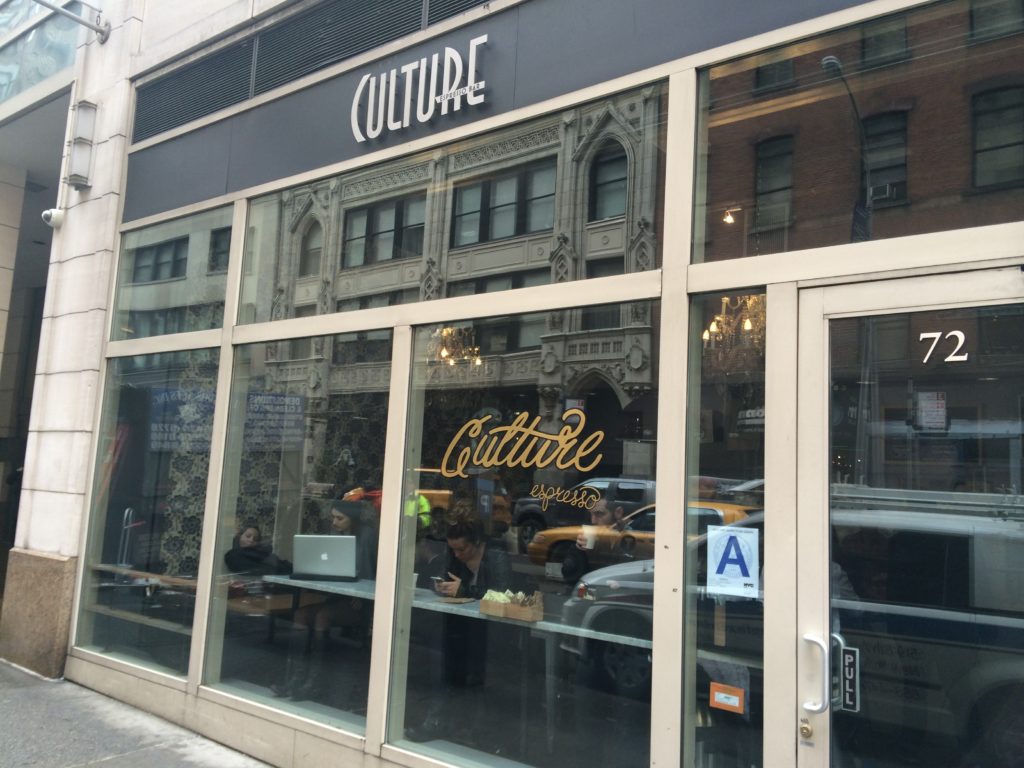
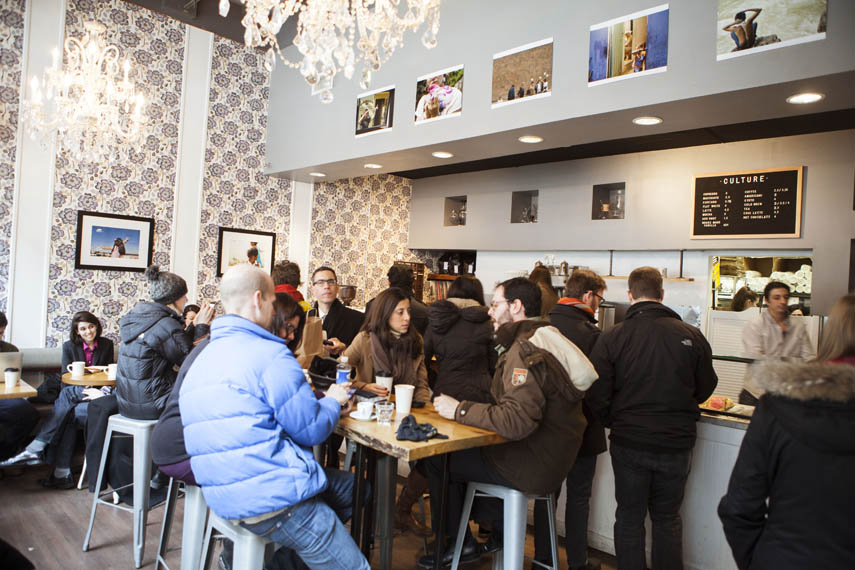
Firstly, this independent coffee shop is pleasing to the eye from both the outside and the inside. As you can see for yourself in the pictures below.

DISH OF THE WEEK: Chocolate Chip Cookie at CULTURE ESPRESSO | Eat ...
(Image from: Eat This New York


The 25 Best Artisanal Coffee Shops in America
(Imagine from: Spoon University)

It doesn't scream coffee shop in your face at first glance but it truly looks like an art shop from the looks of it. Coffee must be their form of art based upon what I have seen throughout my research.

The coffee shop has such a welcoming environment and an artist aesthetic feel to the shop. It is well known for its espressos and their delicious home-made chocolate chip cookies! Coffee and cookies may not be everyone's go to but in my opinion it is a perfect combination and I hope that I can try both of them from this coffee shop one day.

Coffee is the culture in American and Culture Espresso is the perfect marking name for an independent shop to get the attentions of busy Americans.

-- Shaniely Fernandez Chico

Friday, April 24, 2020

Sawada Coffee - Chicago

An April 2020 Remote Review

The coffee shop that I have chosen to research is called Sawada Coffee. There are two locations of the restaurant; one location is in New York, the other is in Chicago, Illinois. The founder of the restaurant is named Hiroshi Sawada. Hiroshi is a famous barista and “latte art expert."

The atmosphere of the website is warm. My first impression is that the coffee shop is quaint and rustic.The first thing I saw on the website was marvelous photography. The entire backdrop of the website is pictures from the restaurant in scroll style. First, there is a picture of the indoor setting, then an elegant cup of frothy green tea and then artsy looking coffee. There are also pictures of people laughing and having a good time with one another, and a lot of food. The images on the screen are the only thing that can be seen, other than three dots indicating a drop down menu.This shows the website’s visitor that Sawada Coffee associates take pride in the products they make, and the friendships that they facilitate. 

The drop-down menu allowed me to click on “Food and Drinks Menu," which led me to an impressive menu full of things that I would love to try. They have a section in their menu for Espresso, Coffee, Matcha, Tea, Boozy Steamers (which is alcoholic coffee), Doughnut, Morning Snacks, and Sweet Treats. Each menu section has numerous items that can be ordered in different sizes, which is pretty standard for a restaurant menu. The restaurant’s main focus is Coffee, so that should have been clear to the guest by viewing the menu, but it is not. They have so many things on their menu that it could easily get overwhelming while ordering in person. On this menu, I would love to try the Matcha Latte under Matcha, which costs $5.70. This drink intrigues me because it is so expensive, and it is something that I have never tried before. Another thing on the menu that I would like to try is the High Five Mocha under Espresso. That seems like an interesting treat, and I would like to try it because I want to find out what the High Five is in the drink! 

Overall, I would definitely like to try this coffee shop. The restaurant could have made its coffee sources more well known to the consumer, so that way they can make a conscious and educated decision while buying their product. Prices are extremely high at this place, and I would like to know if it is because of the quality of the coffee, and if it is, why don’t they share with their guests where the coffee comes from? If I ever go to Illinois, I will be sure to stop in. 

Here is the link to the website in case you’d like to research it and potentially try it someday! 
http://sawadacoffee.com/chicago/

-- Mackayla Gouvia

Coffee Maven Postscript: My son lives in Chicago, so Sawada is on my list to visit as soon as travel is possible.

Tuesday, April 7, 2020

Nighthawks: Third Placeless


via GIPHY

I might have learned of Nighthawks by Edward Hopper from the board game Masterpiece. This game involved auctioning works of art, and was mildly educational since the back of each game card included at least the title and author. Each edition of the game featured paintings from.a different real museum, and the 1976 edition included only works from the Art Institute of Chicago. I knew nothing about that museum that begins Route 66, nor about the college housed inside its walls, nor that my own child would eventually be educated as an artist at that college!

Wherever I first saw the image of the Nighthawks, I know where I was when I first saw the original painting. It was part of a 2007 Edward Hopper exhibition at the Museum of Fine Arts in Boston. I am pretty certain that something else had drawn us to the exhibit, because when I saw this on the wall, I was stopped in my tracks. And then I was drawn to it. Drawn into it. I knew not to get close enough to set off the electronic alarm, but I think I did get close enough to draw the attention of a human guard. I was mesmerized. It measures 33-1/8 by 60 inches -- large for a painting, but not as large as I remember it. I felt as if I could lean against the glass, and somehow push through it.

I never noticed, as the AIC notes point out, that the Hopper deliberately avoided any reference to an entrance. This was part of Hopper's genius in drawing the viewer into the scene, while excluding us from it. Hopper also populated the café with four individuals who were essentially alone together in this space. Years later, Ray Oldenburg and other social critics would include cafés as typical of what he called a "third place" -- neither home nor work.

Hopper's original nighthawks do not exhibit the conviviality that Oldenburg and others typically associate with those third places, but they are drawn to a place that is optional. Those on the far side of counter have no obligation -- familial, financial, or otherwise -- to be there. Engagement with other visitors is also optional, and in Hopper's glimpse it is eschewed. But clearly, it is what the visitor in the GIF above craves. I do not know when this parody was created, but it certainly resonates with the current company-craving gestalt of a world in various stages of quarantine.

NOTE: Strange as this will seem to some readers, I use "the visitor in the GIF" because it only slowly occurred to me that this is John Travolta, in a scene from Pulp Fiction. In my defense, I saw that movie only once, a very long time ago. He looks confused, and in fact this is a popular meme known simply as Confused Travolta. Thanks to students in my Spring 2020 seminar Secret Life of Coffee for helping me figure this out. During a Zoom meeting, of course.

Lagniappe

I post this parody because of the geographies it so deftly brings to mind -- the geographies of coffee shops and community in more ordinary times. I post it for the benefit of my coffee students, who mainly study where coffee comes from, but who also analyze the places it goes to.

The rest of the posts in this blog relate to cafés that were -- by definition -- open when my students or I went to visit them. In late March and April of almost every year since 2007, students have told me and each other about the third places" they have visited in their hometowns or far away.

They have tried to figure out what made them successful (which they had to be to some extent, to be open when a well-financed franchise is never more than a mile or so away) and how they fit into their neighborhoods.

Perhaps my first encounter with the original painting captivated me so deeply because it was within a couple months of the first dozen or so of these student presentations. I have enjoyed hundreds of them since then -- including reviews of cafés that are since defunct.

This spring, my students have a different assignment: they are writing about cafés elsewhere (each has been assigned a state outside of New England), because their research perforce does not include. site visit. They will be learning about the cafes remotely -- as will students in my Coffee Week summer class if we are able to offer it. In many cases, the ways that the cafés find a new role in their communities -- with some combination of curbside pickup, delivery, charitable work or virtual gathering -- will be an important part of the story they tell.

Inauguration 2021 Update 

Inevitably ... 


And Campaign 2024 Update 

(With apologies for reposting an image of the most over-exposed person of our times.

During the 2024 campaign for election to the office of President of the United States, a certain former occupant became a little desperate and began exaggerating even more than usual about the number of people supporting his campaign and attending his events. 

He had the support of "hundreds of governors" out of a possible 50. Crowds at his rallies were 10, 20, or even 30 times the size of those attending the events of his rivals -- as if arenas that could hold a half million "fans" even exist. 

All of this led to some meming, and one result is a variation on Nighthawks that I call Nighthawk. As with all such rapidly-spreading imagery, I do not know the artist who deserves the credit. 


Monday, May 13, 2019

Golden Apple Chicago Diner

Recommended Listening from the Coffee Maven
24 Hours at the Golden Apple, This American Life
Painting by Steve Connell
My interest in the geography of coffee began at the global scale, in the places from which coffee originates and the patterns of its movement from seed to cup. Those who know my coffee work are aware that my emphasis is on the environmental and social impacts of these geographies.

But readers of this blog -- and students in the second-year seminar that produces most of its posts -- know that I am also interested in the neighborhood-scale geography of coffee shops. I use the term to refer to a variety of independent, coffee-forward businesses, inclusive of those that curate excellent coffee and those that treat it as a utility in service of breakfast. Over the past decade, students in my seminar course have told their classmates and me about a few hundred places that span the entire coffee-shop gamut.

I have not been to the Golden Apple diner in Chicago, though I sit just a mile or so from it as I write this, but I suspect that it falls in the latter of these categories, and despite my desire for a world full of ethical coffee, I'm OK with that for now.

Way back in 2000, a team of some of my favorite journalists spent 24 hours trying to interview every person who came in the door. The result is a full hour of exquisite first-hand accounts of what makes places like this hubs of their respective communities. From the adorable to the pathetic and even unlikeable, a cross-section of the neighborhood as diverse as the neighborhood itself comes through the doors.

Settle in with a nice cuppa and give yourself the gift of an hour of excellent radio: 24 Hours at the Golden Apple, recently rebroadcast on This American Life.

Lagniappe: Chicago is, of course, full of great diners, of which I have enjoyed a few. Even when hotels include an alleged breakfast buffet in the price of a room, we usually prefer to find such places. But this year I found Ray's Bucktown B&B, where I have enjoyed phenomenal breakfasts every morning of three different stays while visiting my kid in the city.